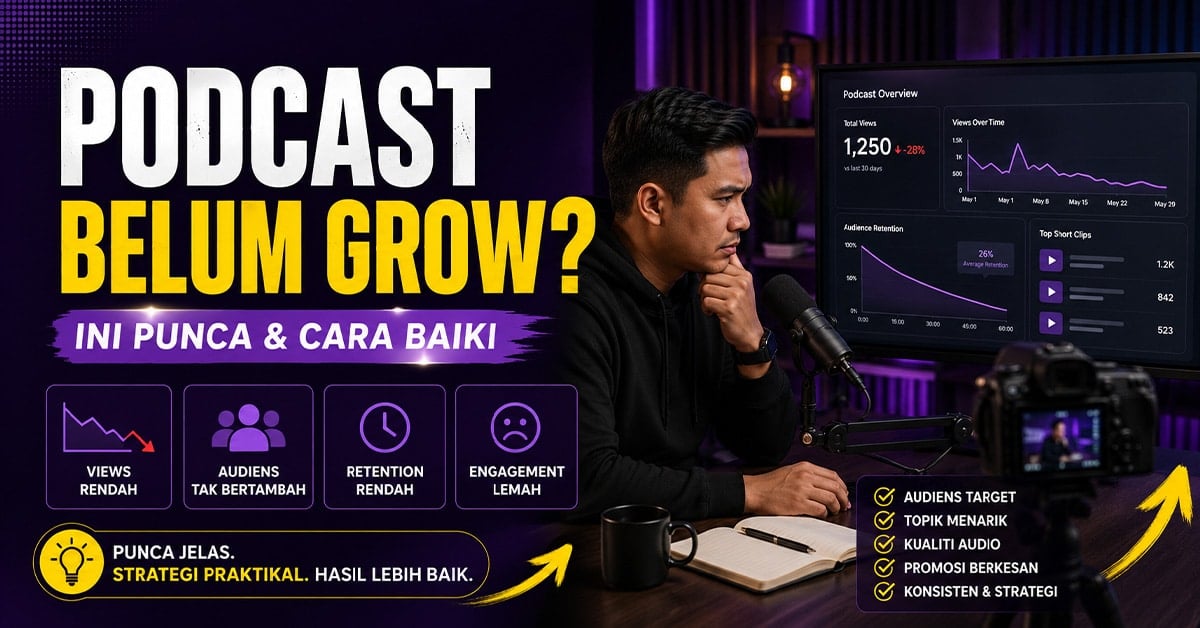
Podcast growth in 2026 is still very real — but the way podcasts grow has changed.
If you feel like podcasting is already too crowded and you have missed the wave, that worry makes sense. New shows are launching all the time, big creators dominate social feeds, and short-form video seems to take most of the attention.
But here is the good news: podcasts still grow in 2026. The difference is that growth is no longer just about uploading audio and waiting for people to find you.
Today, podcast growth depends on discoverability, video, consistency, niche positioning, short clips, strong titles, and the ability to distribute one episode across multiple platforms.
In this article, we will break down what is happening in the podcast market, why podcasts are still growing, and what actually works now if you want to grow a podcast in 2026.
Trying to stay consistent with your podcast?
Read this guide too: How to Keep Your Podcast Consistent When Life Gets Busy
Quick Answer: Do Podcasts Still Grow in 2026?
Yes, podcasts still grow in 2026. But growth now comes from a combination of clear niche positioning, video podcast discovery, short-form clips, consistent publishing, strong episode titles, and multi-platform distribution.
Audio-only podcasts can still work, but video podcasts and short clips make discovery much easier because people are now finding podcasts through YouTube, TikTok, Instagram Reels, LinkedIn and YouTube Shorts.
Podcast Growth in 2026: What Has Changed?
Podcasting is no longer a small niche. It has become a normal way for people to learn, follow creators, discover stories, understand brands, and consume long-form conversations.
According to Edison Research’s Infinite Dial 2026, podcast consumption in the United States reached record highs, with 58% of Americans aged 12 and above consuming a podcast in the last month and 45% consuming a podcast in the last week.
This matters because podcasting is no longer something people need to be educated about. Audiences already understand the format. They know how to search for shows, follow creators, and watch or listen to long-form content on platforms they already use.
The challenge for creators is no longer “will people listen to podcasts?” The better question is: how do you make your podcast easier to discover and easier to follow?
1. The Audience Is Still Expanding
The biggest reason podcasts still grow in 2026 is simple: the audience is still there.
Podcasting has moved from early adopter behaviour to a mainstream content habit. People use podcasts for education, entertainment, business, self-growth, career advice, parenting, news, health, comedy, spirituality, culture and community.
When a format becomes normal, new shows still have room to grow — especially when they serve a clear audience with a clear promise.
What This Means for New Podcasters
- You do not need to reach everyone.
- You need to be clear about who your podcast is for.
- You need titles that match what people actually search for.
- You need topics that solve real problems or satisfy real curiosity.
- You need consistency so people know what to expect from your show.
People search for solutions, stories and perspectives. They rarely search for vague show titles. That is why your episode titles, descriptions and clips need to explain the value clearly.
2. Video Podcast Is Now a Major Growth Engine
In 2026, podcast growth is strongly connected to video.
YouTube announced in 2025 that there are more than 1 billion monthly active viewers of podcast content on YouTube. That is a major signal that podcasts are no longer only audio experiences.
Video podcasts help people discover shows through search, recommendations, short clips, suggested videos, TV viewing, and social media sharing.
This does not mean audio is dead. It means podcasts have become a dual-format medium. Some people listen. Some people watch. Some discover through video first, then follow the audio version later.
Why Video Helps Podcast Growth
- It makes the host and guests more visible.
- It allows clips to be used on TikTok, Reels, Shorts and LinkedIn.
- It gives YouTube more content to recommend and index.
- It helps audiences connect with facial expression, body language and studio presence.
- It gives creators more content assets from one recording session.
If you want your podcast to grow in 2026, video is one of the most practical ways to increase discovery.
3. Short Clips Are the New Podcast Trailer
A full episode may be 30 minutes, 60 minutes or longer. But most new listeners will not start there.
Many people discover podcasts through a short clip first. They see a bold statement, funny moment, emotional story, useful tip or strong opinion. If the clip works, they may click into the full episode or follow the show.
This is why short clips are no longer optional for many podcasts. They are the modern trailer for your full episode.
What Makes a Podcast Clip Work?
- A strong hook in the first 1 to 3 seconds.
- A clear topic that people understand without too much context.
- Good audio and readable captions.
- A moment that creates curiosity, emotion or value.
- A clear CTA to watch or listen to the full episode.
One podcast episode can become several short clips, each with a different angle. One clip can focus on a problem. Another can focus on a quote. Another can focus on a funny reaction or strong opinion.
Want to turn one podcast into multiple social posts?
Read this guide: Cara Kitar Semula Kandungan Podcast Untuk Media Sosial
4. Podcast Growth Is Less About Virality and More About Repeated Exposure
Going viral can help, but virality is not a strategy you can fully control.
What you can control is repeated exposure. When your audience sees your clips, episode titles, quotes and full episodes consistently, they begin to understand what your podcast is about.
Most loyal listeners do not become fans from one random post. They become fans after seeing your content several times, understanding your niche, and trusting that your show delivers a certain type of value.
The 2026 Podcast Growth Formula
- Pick one clear audience: Do not try to speak to everyone.
- Choose one content promise: What value does your show repeatedly deliver?
- Publish consistently: Weekly or biweekly is better than random uploads.
- Record video when possible: It gives you more distribution options.
- Cut short clips: Use clips as discovery assets.
- Use clear titles: Make the value obvious before people click.
- Track what works: Look at retention, comments, shares and full-episode views.
Podcast growth in 2026 is not only about making a good episode. It is about making sure the right people can discover that episode repeatedly.
5. Brands Are Still Investing in Podcasts
Another reason podcasts still grow is that brands continue to invest in the medium.
The IAB U.S. Podcast Advertising Revenue Study, prepared by PwC, projected U.S. podcast advertising revenue to approach the $2.6 billion mark by 2026.
This matters because ad spending follows audience attention. If brands continue to invest, platforms, creators and production companies will also keep improving the ecosystem.
Even if you are not chasing sponsorships today, this is still useful. A healthy podcast market means more awareness, better tools, more advertisers, and more proof that podcasts can support business goals.
How Small Podcasts Can Become Sponsor-Ready
- Keep your niche clear.
- Know who your audience is.
- Publish consistently.
- Maintain clean audio and professional presentation.
- Track basic metrics such as views, downloads, retention and engagement.
- Create a simple media kit when you are ready.
Small podcasts can still be valuable if they reach a specific audience that brands care about.
6. Platforms Are Competing for Podcast Attention
Podcast growth is also supported by platform competition.
Spotify reported in Q1 2026 that it reached 761 million monthly active users and 293 million premium subscribers. The company also mentioned continued investment in personalization, infrastructure and tools for creators.
When major platforms invest in discovery, analytics, video, recommendations and creator tools, podcasters benefit.
This does not mean every show will grow automatically. But it does mean creators now have more entry points: YouTube search, Spotify recommendations, Apple Podcasts, TikTok clips, Reels, Shorts, newsletters, LinkedIn and website SEO.
Where Podcast Discovery Happens in 2026
| Platform | Role in Growth | Best Use |
|---|---|---|
| YouTube | Search, recommendations and video discovery | Full video episodes, clips, playlists, Shorts |
| Spotify | Podcast listening, following and audio/video discovery | Audio episodes, video podcast, audience analytics |
| TikTok / Reels / Shorts | Fast discovery and social reach | Short hooks, hot takes, emotional clips, funny moments |
| Professional visibility and thought leadership | Business clips, founder insights, expert conversations | |
| Website / Blog | SEO and long-term discoverability | Episode summaries, articles, show notes, transcripts |
| Email / Community | Retention and direct audience relationship | Episode recaps, private updates, subscriber content |
7. Clear Niche Beats Generic Content
In a crowded market, generic content gets ignored faster.
If your podcast is about “everything”, it becomes harder for new listeners to understand why they should follow. But if your podcast serves a specific audience with a specific promise, it becomes easier to remember.
A strong niche does not make your audience smaller in a bad way. It makes your value clearer.
Examples of Clear Podcast Positioning
- For founders: Real stories about building small businesses in Malaysia.
- For young professionals: Career growth, money, confidence and workplace survival.
- For parents: Honest conversations about parenting, family and child development.
- For creators: Practical content creation, gear, workflow and monetization.
- For brands: Corporate storytelling, leadership and industry education.
Clear positioning makes your podcast easier to recommend. When people know exactly who your show is for, they can share it with the right people.
8. Consistency Still Matters More Than Perfect Production
Production quality matters, but consistency matters even more.
A beautiful podcast setup cannot help much if you only publish once and disappear for three months. On the other hand, a clear and consistent show can improve over time as the host, format and workflow get stronger.
The best approach is to create a schedule you can actually sustain.
Simple Publishing Options
- Weekly: Best if you have enough time, team and content pipeline.
- Biweekly: More realistic for many creators and businesses.
- Seasonal: Good for corporate podcasts or structured shows.
- Monthly: Better than random uploads if the quality and promotion are strong.
Consistency helps audiences build habits. It also helps your team plan recording, editing, publishing and promotion without last-minute stress.
Need help with podcast workflow?
Read this guide: Workflow Podcast Untuk Beginner: Dari Idea Sampai Promosi
What Actually Works for Podcast Growth in 2026?
If we simplify everything, podcast growth in 2026 comes down to making your show easy to discover, easy to understand, and easy to follow.
What Works Now
- Video podcast: Helps with YouTube discovery and short-form clips.
- Short-form distribution: Turns one episode into many discovery points.
- Clear titles: Helps people understand the value before clicking.
- Strong hooks: Makes clips and episodes more engaging from the start.
- Consistent schedule: Builds audience habit and trust.
- Specific niche: Makes your show easier to remember and recommend.
- Repurposed content: Helps you show up on multiple platforms without starting from zero every day.
- Analytics: Helps you improve based on retention, watch time and engagement.
What Does Not Work Anymore
- Uploading random episodes without a clear audience.
- Using vague titles that do not explain the value.
- Publishing only the full episode without clips or promotion.
- Copying big creators without understanding your own niche.
- Waiting for virality instead of building a repeatable system.
- Ignoring audio quality, framing and basic production standards.
Checklist: Is Your Podcast Built for Growth?
Use this checklist to see whether your podcast has the right foundation for growth in 2026:
- Is your target audience clear?
- Can someone understand your podcast promise in one sentence?
- Do your episode titles answer a question or solve a problem?
- Do you publish consistently?
- Do you record video when possible?
- Do you cut each episode into short clips?
- Do your clips have strong hooks?
- Do you post on platforms where your audience already spends time?
- Do you track retention, watch time, comments, shares and full-episode clicks?
- Do you have a simple workflow for recording, editing, publishing and promotion?
If you can improve even a few of these areas, your podcast will have a stronger chance to grow.
Next Big Opportunity: Internal Podcasts for Companies
One of the strongest podcast opportunities in 2026 is not only public shows. It is also internal podcasts for companies.
As more businesses think about culture, onboarding, training, leadership communication and employer branding, podcasts can become a useful internal communication tool.
Instead of long emails or repeated briefings, companies can use internal podcasts for leadership updates, new joiner stories, training explainers, culture communication and staff learning.
This is why our upcoming article, Why Malaysian Companies Are Starting Internal Podcasts in 2026, is a strong follow-up topic. It connects directly with the growth of corporate podcasts, employer branding, and internal communication.
Final Thoughts: Podcasts Still Grow, But Strategy Matters More
So, do podcasts still grow in 2026? Yes.
The audience is still expanding, video podcasts are accelerating discovery, ad revenue projections show continued market confidence, and major platforms are still investing in podcast experiences and creator tools.
But growth is no longer about uploading and hoping. Podcast growth in 2026 depends on strategy: clear niche, strong content promise, consistent publishing, video distribution, short clips, useful titles and proper repurposing.
If you make your podcast easy to discover, easy to understand and easy to follow, you give it more chances to grow — even without going viral.
FAQ: Podcast Growth in 2026
1. Do podcasts still grow in 2026 if I start from zero?
Yes. New podcasts can still grow in 2026, especially if they focus on a clear audience, publish consistently, use strong episode titles, and distribute clips across platforms like YouTube, TikTok, Reels and Shorts.
2. Do I need video to grow a podcast?
You do not strictly need video, but video makes discovery much easier. Video podcasts can be published on YouTube and turned into short clips for social media.
Audio-only can still work if the niche is strong, the show is consistent, and the audience already prefers listening.
3. How long does it take to see podcast growth?
It depends on the niche, content quality, publishing schedule and distribution strategy. Many shows need a few months of consistent publishing before seeing clear patterns.
Instead of judging from one episode, track trends across 6 to 10 episodes.
4. What podcast topics grow well in 2026?
Topics with strong audience intent tend to perform well. Examples include business stories, career advice, education, personal growth, parenting, finance, health, creator economy, niche communities and industry insights.
The key is not only the topic, but how clearly you serve a specific audience.
5. Can small podcasts still get sponsors?
Yes. Small podcasts can still attract sponsors if they have a specific niche, clear audience, consistent publishing and strong brand fit.
A smaller but engaged audience can be more valuable than a broad audience with weak connection.
Ready to Grow Your Podcast in 2026?
Record your podcast at KL Podcast Studio and get a professional setup with camera, lighting, audio, and production support — so your content looks better, sounds cleaner, and becomes easier to repurpose into clips.