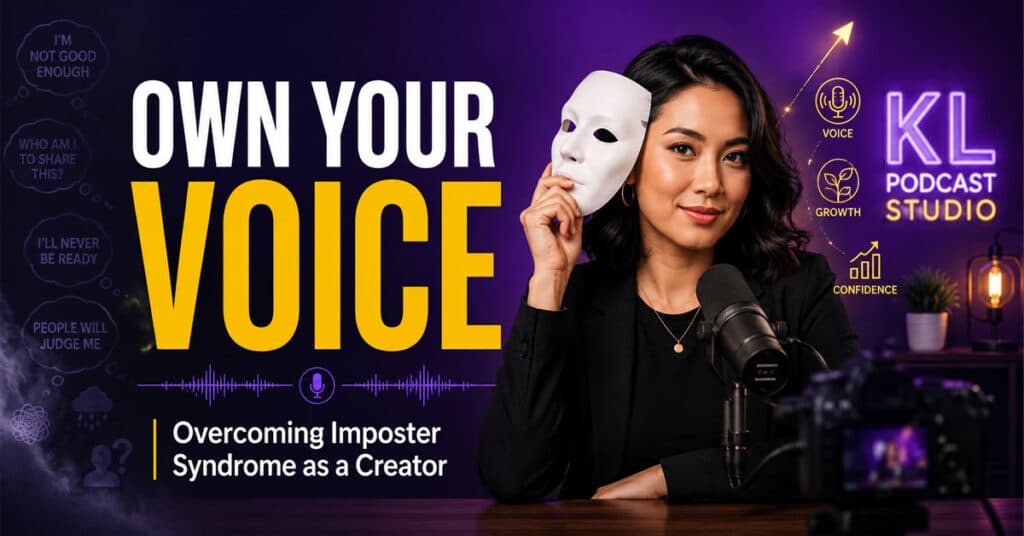
Overcoming imposter syndrome as a content creator is not about becoming fearless. It is about learning how to create even when doubt shows up.
If you have ever sat in front of a microphone, looked at the camera, and suddenly thought, “Who am I to talk about this?” — you are not alone.
Many creators, podcasters, founders, educators, coaches and professionals feel this quietly. You may have the knowledge. You may have the experience. You may even have people asking you to share more. But when it is time to record, post or speak publicly, that small voice appears:
“What if people judge me?”
“What if I sound stupid?”
“What if I am not expert enough?”
“What if everyone finds out I am not as good as they think?”
That feeling is often called imposter syndrome or the impostor phenomenon. It can make talented people delay their content, overthink every line, avoid the camera, or never publish the ideas that could actually help someone.
In the creator economy, especially in 2026 where everyone looks polished on TikTok, YouTube, Instagram and LinkedIn, it is easy to compare your messy behind-the-scenes with someone else’s final edit.
But here is the truth: feeling like an imposter does not mean you are fake. Sometimes, it simply means you care about doing good work.
In this guide, we will break down why content creators struggle with imposter syndrome, how to own your voice, and how to build confidence before recording your next podcast, video or content piece.
Want to build credibility through podcasting?
Read this article too: 5 Cara Podcast Bina Kredibiliti dan Personal Branding Anda
Quick Answer: How Do Creators Overcome Imposter Syndrome?
Content creators can overcome imposter syndrome by shifting their focus from perfection to contribution. Instead of asking, “Am I good enough?”, ask, “Who can this help?”
Confidence grows when you create consistently, collect proof of your progress, speak from your own experience, and stop comparing your early work to someone else’s highlight reel.
What Is Imposter Syndrome?
Imposter syndrome is the feeling that you are not as capable, qualified or deserving as other people think you are — even when there is evidence that you are doing meaningful work.
For content creators, it often shows up before publishing, recording, pitching, speaking, teaching or appearing on camera.
For Creators, It Can Sound Like This:
- “I am not expert enough to talk about this.”
- “Other creators are already doing this better.”
- “People will judge my voice, face or accent.”
- “I need to learn more before I start.”
- “My content is too simple.”
- “What if nobody cares?”
The problem is not only the feeling itself. The bigger problem is what the feeling makes you do: delay, hide, over-edit, avoid posting, or abandon an idea before it has a chance to grow.
Important note: this article is for general creator confidence and content strategy. It is not a replacement for professional mental health support. If your anxiety feels overwhelming or affects your daily life, speaking with a qualified professional can help.
Why Content Creators Struggle With Imposter Syndrome
Content creation is public. That is what makes it powerful, but also what makes it scary.
When you post a video, record a podcast or share an opinion, you are not just doing the work. You are also letting people react to your work.
This is why creators often feel exposed. Your face, voice, ideas, story, background and personality become part of the content.
Common Reasons Creators Feel Like Imposters
- Comparison: You compare your first episode to someone’s 500th episode.
- Perfectionism: You feel content must be flawless before it is worth publishing.
- Too much consumption: Watching too many creators can make you doubt your own voice.
- Fear of judgement: You worry what friends, colleagues or strangers will think.
- Unclear positioning: You are not yet sure what your content stands for.
- Lack of repetition: You have not created enough times to feel comfortable yet.
At KL Podcast Studio, we often see first-time hosts and creators feel nervous before recording. But once the conversation starts, many of them realize they are more prepared than they thought.
Confidence often comes after action, not before it.
Imposter Syndrome vs Growth Mindset
The goal is not to pretend you never feel doubt. The goal is to respond to doubt differently.
This table can help you reframe the voice in your head:
| Aspect | Imposter Syndrome Thinking | Growth Mindset Thinking |
|---|---|---|
| Failure | “This proves I am not good enough.” | “This shows me what to improve next.” |
| Other Creators | “Their success means there is no space for me.” | “Their success shows this topic has an audience.” |
| New Content | “I will be exposed.” | “I will improve by doing.” |
| Feedback | “This is a personal attack.” | “This is data I can learn from.” |
| Expertise | “I need to know everything before I speak.” | “I can share what I know honestly and keep learning.” |
You do not need to be the world’s top expert to help someone. Sometimes, you only need to be a few steps ahead of the person you are speaking to.
1. Shift From “Am I Good Enough?” to “Who Can This Help?”
The fastest way to reduce imposter feelings is to move the focus away from your ego and toward your audience.
When the question is “Am I good enough?”, everything becomes about proving yourself. That creates pressure.
But when the question becomes “Who can this help?”, your attention moves toward contribution.
Try These Reframes:
| Instead of Thinking | Try Thinking |
|---|---|
| “Why would anyone listen to me?” | “Who might need to hear this from someone like me?” |
| “This has already been said.” | “It has not been said from my experience and perspective.” |
| “I am not expert enough.” | “I can share what I know honestly and responsibly.” |
| “What if people judge me?” | “The right audience will care about the value, not perfection.” |
Your content does not need to impress everyone. It only needs to be useful, honest or meaningful to the right people.
2. Document, Do Not Overperform
One reason creators feel like imposters is because they think every post must be a polished expert lesson.
But content does not always need to be “I know everything.” Sometimes, content can be “Here is what I am learning.”
This is especially helpful for beginner creators, podcasters and founders.
You Can Document:
- What you are learning this week.
- Mistakes you made and what they taught you.
- Behind-the-scenes of your work or creative process.
- Questions you are exploring.
- What surprised you after talking to a guest.
- How your opinion changed over time.
Documenting removes the pressure to act like a perfect expert. It allows your audience to follow your journey, not just your results.
For podcasts, this works very well because people enjoy hearing the process behind the person. They want the real story, not just the final polished answer.
Want to use podcasting as your storytelling space?
Read this article: Kenapa Podcast Jadi Ruang Cerita Buat Content Creator?
3. Build a “Win Folder”
When you feel like an imposter, your brain often forgets evidence that you are doing something meaningful.
That is why a “Win Folder” can help.
A Win Folder is a simple folder on your phone, laptop or notes app where you save proof that your work has helped someone.
What to Save in Your Win Folder:
- Positive comments.
- Messages from people who found your content useful.
- Client or audience feedback.
- Screenshots of people sharing your content.
- Milestones such as first upload, first 100 views, first guest or first enquiry.
- Private notes about things you handled better than before.
This is not about feeding your ego. It is about collecting evidence.
When self-doubt appears, open the folder and remind yourself: this work has already helped someone.
4. Stop Trying to Be Original. Start Being Personal.
Almost every topic has been discussed before.
There are already videos about business. Podcasts about confidence. Articles about content strategy. Interviews about leadership. Tutorials about camera setup.
That does not mean your voice is unnecessary.
The value is not always in a brand-new topic. Sometimes, the value is in your angle, your story, your language, your examples and your lived experience.
Your Perspective Can Come From:
- Your background.
- Your industry experience.
- Your culture and local context.
- Your mistakes.
- Your journey as a beginner or founder.
- Your way of explaining something simply.
- Your personal values and point of view.
For Malaysian creators, this is powerful. You do not need to sound like a creator from the US, UK or anywhere else. Your local context, language, humour, struggles and stories are part of what makes your content valuable.
The goal is not to sound like everyone else. The goal is to sound like someone your audience can trust.
5. Use Structure to Reduce Anxiety
Confidence does not always come from motivation. Sometimes, confidence comes from structure.
If you sit down to record with no outline, no clear topic and no direction, you will naturally feel more nervous. Your brain has too many things to solve at once.
A simple structure gives you something to lean on.
Simple Podcast Confidence Structure
| Part | What to Prepare | Why It Helps |
|---|---|---|
| Opening | One sentence explaining the topic | Helps you start clearly |
| Main Points | 3 to 5 bullet points | Gives the episode direction |
| Examples | 1 to 2 real examples or stories | Makes the content more personal |
| Takeaway | One key message for the audience | Gives the episode purpose |
| CTA | What the audience should do next | Helps you end confidently |
You do not need to script every word. In fact, reading a full script can sometimes make you sound stiff. A strong outline is usually enough to keep you confident and natural.
Need help planning your episode structure?
Read this article: Cara Rancang Episode Podcast: Dari Idea ke Skrip
6. Master Your Environment
Sometimes, your confidence is affected by your environment.
If your microphone sounds bad, your lighting is too dark, your camera angle feels awkward, or your background looks messy, you will naturally feel more self-conscious.
A better environment does not magically remove self-doubt, but it can reduce unnecessary anxiety.
A Good Recording Environment Helps Because:
- You stop worrying about audio quality.
- You look more professional on camera.
- You feel more prepared when the setup is ready.
- Your guest feels more comfortable.
- You can focus on the conversation instead of technical problems.
This is one reason professional podcast studios can help new creators. When the microphone, camera, lighting and recording workflow are prepared, you can focus on your message.
For video podcasts, platforms are also becoming more creator-friendly. YouTube has official podcast creation features inside YouTube Studio, and Spotify for Creators supports video podcast uploads, allowing creators to publish video episodes while still distributing audio through RSS to other listening platforms.
Still wondering why video podcast matters?
Read this article: Kenapa Video Podcast Bukan Lagi Pilihan, Tapi Keperluan
7. Practice Micro-Wins
When imposter syndrome appears, creators often think too far ahead.
They worry about the full episode, the audience reaction, the comments, the algorithm, the next 10 episodes, and whether the whole project will work.
That is too much pressure.
Instead, focus on micro-wins.
Examples of Micro-Wins
- Recording a clean 30-second intro.
- Finishing one episode outline.
- Posting one short clip.
- Asking one guest a better follow-up question.
- Improving your lighting from the previous episode.
- Speaking more naturally than last time.
- Publishing even when it is not perfect.
Confidence is built through repeated evidence that you can do the work.
Small wins matter because they give your brain proof: I can handle this.
8. Separate Criticism From Identity
When you publish content, feedback will come.
Some feedback will be helpful. Some will be unclear. Some may be negative. And sometimes, people will simply not respond at all.
This can trigger imposter feelings, especially when you attach your identity too closely to the performance of one piece of content.
Try to separate the work from your worth.
Healthy Ways to Handle Feedback
- Look for patterns, not one random comment.
- Take useful criticism and ignore insults.
- Ask: “What can this teach me?”
- Do not measure your value by one post or one episode.
- Remember that slow growth does not mean failure.
Your content can improve without you attacking yourself.
This is one of the biggest mindset shifts for creators: feedback is information, not a final judgment.
9. Own Your Voice Before the Algorithm Does
One of the dangers of content creation is letting the algorithm decide your identity.
If one type of post performs well, you may feel pressured to repeat it forever. If one video performs badly, you may think your voice has no value.
But your creative voice should not be fully controlled by metrics.
Metrics are useful, but they are not the whole story.
To Own Your Voice, Ask:
- What do I want to be known for?
- What topics can I speak about with honesty?
- What values should my content carry?
- What audience do I actually want to serve?
- What type of content can I sustain without losing myself?
Owning your voice means you are not only chasing what performs. You are building something that still feels like you.
Not sure what podcast format fits your voice?
Read this article: Cara Pilih Format Podcast Yang Sesuai Sebelum Mula Rakam
Confidence Reset Checklist Before You Record
Use this checklist before your next podcast, video or content recording session:
- Identity Check: Am I trying to copy someone else, or am I speaking as myself?
- Value Check: What is one useful thing the audience can take from this?
- Structure Check: Do I have 3 to 5 clear points?
- Environment Check: Is my audio, camera and lighting ready?
- Audience Check: Who am I helping with this content?
- Evidence Check: What past win proves that my voice has value?
- Body Check: Have I taken a breath, relaxed my shoulders and slowed down?
- Release Check: Can I publish this without needing it to be perfect?
The goal is not to remove nerves completely. The goal is to create even with the nerves present.
Common Mistakes Creators Make When Fighting Imposter Syndrome
Sometimes, creators try to solve imposter syndrome in ways that actually make it worse.
Avoid These Mistakes:
- Waiting until you feel confident: Confidence usually comes after repetition.
- Over-consuming other creators: Too much comparison can weaken your own voice.
- Trying to sound like an expert all the time: Honest learning can be more relatable.
- Changing niche too quickly: Give your voice time to develop.
- Judging yourself too early: Your first few videos or episodes are practice, not your final identity.
- Confusing simplicity with lack of value: Simple content can be powerful when it solves a real problem.
How KL Podcast Studio Can Help Creators Feel More Confident
At KL Podcast Studio, we cannot remove every creator’s self-doubt. But we can remove many of the technical worries that make self-doubt louder.
When you do not have to worry about whether the camera is framed properly, whether the microphone is working, whether the lighting looks good, or whether the files are being recorded correctly, you can focus more on your voice, your guest and your message.
Recording in a Professional Studio Helps With:
- Cleaner audio quality.
- Better camera framing.
- Professional lighting.
- A more comfortable recording environment.
- Production support during the session.
- Less technical stress before and during recording.
For many creators, a professional setup can create a psychological shift. You step into the room and feel, “Okay, this is real. I can do this.”
That feeling matters.
FAQ: Imposter Syndrome for Content Creators
1. Does imposter syndrome ever go away?
For many people, it may not disappear completely. But it can become easier to manage when you build evidence, repeat the work, share your feelings with trusted people, and stop expecting perfection from every piece of content.
2. Should I tell my audience I feel nervous?
You can, if it feels natural and appropriate. Vulnerability can build connection when it is honest and not used as a gimmick.
You do not need to overshare, but admitting that you are learning can make your content more human.
3. What if I get negative comments?
Separate useful criticism from insults. If a comment gives clear feedback, consider what you can learn. If it is only meant to hurt, you do not need to build your identity around it.
4. Does professional gear help with confidence?
It can help, especially if technical worries are part of your anxiety. Good audio, lighting and camera setup can reduce stress and help you focus on your message.
However, gear does not replace practice. Confidence still grows through repetition.
5. How do I know if I am ready to start creating?
You are ready enough when you have something useful, honest or meaningful to share. You do not need to know everything before you start.
Start with one topic, one audience, and one simple piece of content.
6. Can KL Podcast Studio help me feel more confident on camera or mic?
Yes. KL Podcast Studio can help by providing a professional recording environment with microphones, cameras, lighting and production support, so you can focus on speaking, sharing and improving your content.
Conclusion: Your Voice Does Not Need to Be Perfect to Be Valuable
Imposter syndrome gets louder when your ideas stay hidden.
The more you avoid creating, the more your brain treats content as something dangerous. But the more you practice, record, publish and improve, the more evidence you build that you can do this.
You do not need to feel like a perfect expert before you start. You can start as someone who is learning, sharing, documenting and helping from where you are.
Your voice matters because your experience, language, perspective and story are not identical to anyone else’s.
So do not wait until you feel fully ready. Prepare enough, record honestly, publish responsibly, and let your confidence grow through action.
Ready to Own Your Voice?
Record your podcast or video content at KL Podcast Studio and get a professional setup with microphones, cameras, lighting and production support — so you can focus on your message, not technical stress.