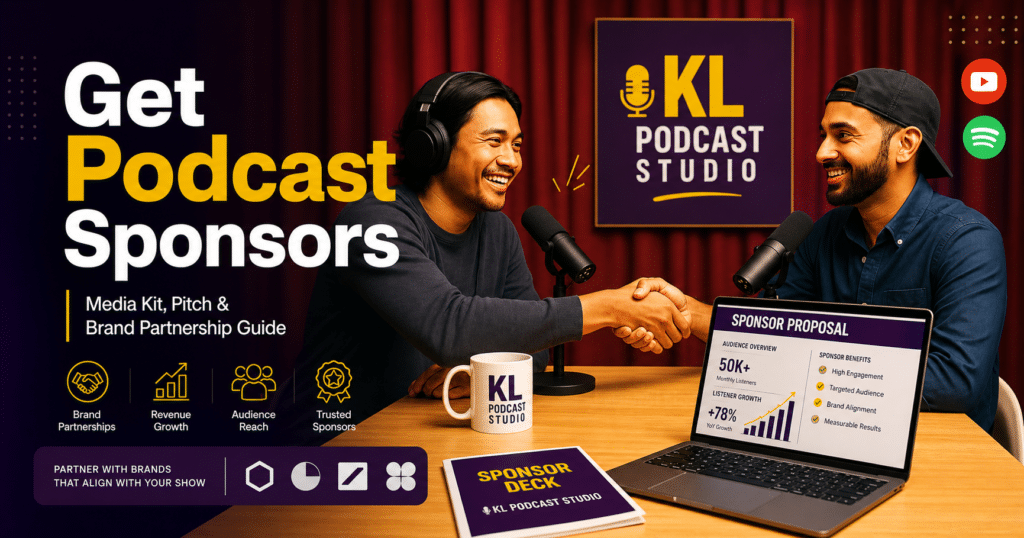
Podcast sponsorship is one of the most popular ways podcasters can monetize their show, but it usually happens after you build the right foundation.
If your podcast is already running, you have been publishing consistently, and your audience is slowly growing, the next question is natural: “How do I get sponsors for my podcast?”
The honest answer is this: sponsors do not only pay for airtime. They pay for access to the right audience, the right trust, and the right content environment.
At KL Podcast Studio, we have seen creators, founders and brands move from casual recording to more sponsor-ready podcast production. The process is not instant, but it is absolutely possible when your podcast has a clear niche, consistent content, engaged audience and a professional pitch.
In this guide, we will break down how to get sponsorship for your podcast, what sponsors look for, how to create a podcast media kit, what to include in your pitch, and how to approach brands in a way that feels professional.
Still figuring out how podcast monetization works?
Read this foundation guide first: Can I Really Make Money Podcasting? Here’s Your Ultimate Guide
Quick Answer: How Do You Get Sponsorship for Your Podcast?
To get sponsorship for your podcast, build a clear audience first, define your niche, create a podcast media kit, prepare sponsorship packages, approach brands that match your audience, and send a personalized pitch.
Sponsors care about audience fit, trust, consistency, content quality, engagement and whether your podcast can help them reach the right people.
What Is Podcast Sponsorship?
Podcast sponsorship is a brand partnership where a company supports your podcast in exchange for exposure to your audience.
This can be as simple as a short ad read in the middle of your episode, or as complete as a full campaign that includes video podcast placement, YouTube mentions, short clips, social media posts, product placement, newsletter mention and event activation.
Common Podcast Sponsorship Formats
- Pre-roll ad: Sponsor mention near the beginning of the episode.
- Mid-roll ad: Sponsor mention during the middle of the episode.
- Post-roll ad: Sponsor mention near the end of the episode.
- Host-read ad: Host personally introduces or recommends the sponsor.
- Sponsored segment: A specific section of the episode is presented by the sponsor.
- Product placement: Sponsor product appears in the video podcast setup.
- Social media bundle: Podcast sponsorship includes TikTok, Reels, Shorts or Instagram Stories.
- Title sponsorship: Sponsor is attached to a series, season or recurring segment.
For most podcasters, the best sponsorship approach is not only selling “a 30-second ad”. It is creating a content package that gives the sponsor visibility across your podcast ecosystem.
1. Build First, Pitch Later
Before any brand sponsors your podcast, they will want to know one thing:
“Who is listening or watching your podcast?”
This does not mean you need millions of views. But you do need to show that your podcast has a clear audience and that people are paying attention.
A smaller podcast with a specific, engaged audience can still be attractive to sponsors if the audience matches the sponsor’s target market.
What You Should Build Before Pitching
- A clear podcast concept.
- A consistent publishing schedule.
- At least a few strong episodes.
- Basic audience data.
- Short clips or social content that show reach and engagement.
- Clean audio and presentable visuals.
- A simple explanation of who your audience is.
Do not rush sponsorship too early. Build enough proof so that when you approach a brand, they can quickly understand the value of your show.
2. Define Your Niche Clearly
Sponsors do not just want “listeners”. They want the right listeners.
This is why your podcast niche matters. A podcast about everything is harder to sponsor because the audience is harder to define. A podcast with a clear niche is easier for brands to evaluate.
Examples of Sponsor-Friendly Niches
| Podcast Niche | Potential Sponsor Type |
|---|---|
| Business and entrepreneurship | Accounting tools, business software, coworking spaces, banks, business events |
| Food and cooking | Restaurants, kitchen tools, food brands, delivery platforms, cooking classes |
| Parenting | Education brands, family products, parenting apps, therapy centres, kids activities |
| Fitness and wellness | Gyms, wellness brands, nutrition services, fitness gear, health platforms |
| Content creation | Camera brands, microphones, lighting, editing tools, creator platforms |
| Career and education | Universities, training providers, HR platforms, online learning tools |
The clearer your niche, the easier it is to answer this question for sponsors: “Why should this brand appear in this podcast?”
3. Know Your Audience Data
You do not need perfect data, but you should understand your audience as much as possible.
Brands want to know who they are reaching. If you can show audience profile, content performance and engagement, your pitch becomes more credible.
Useful Podcast Audience Data
- Average views or downloads per episode.
- YouTube watch time and audience retention.
- Spotify followers or episode performance.
- Top countries or cities.
- Audience age range if available.
- Social media followers and engagement.
- Best-performing clips.
- Comments, DMs, email replies or community feedback.
Spotify for Creators provides tools to manage and grow audio or video podcasts, including analytics and creator features. You can explore the official Spotify for Creators platform for current podcast tools.
If your podcast is on YouTube, you can also use YouTube Studio analytics to understand views, watch time, traffic sources, audience retention and Shorts performance.
4. Create a Podcast Media Kit
A podcast media kit is your sponsorship resume.
It helps brands understand your podcast quickly without asking too many basic questions. A good media kit makes you look more prepared, professional and serious.
Your Podcast Media Kit Should Include:
- Podcast name and tagline: What is your podcast called and what is it about?
- Show description: A short explanation of your podcast concept.
- Host bio: Who is the host and why should people trust them?
- Audience profile: Age range, location, interests, profession or niche if available.
- Platform links: YouTube, Spotify, Apple Podcasts, website and social media.
- Performance data: Average views, downloads, followers, reach or engagement.
- Top episodes: Highlight your best-performing or most relevant episodes.
- Social proof: Testimonials, comments, client names, guest names or community feedback.
- Sponsorship options: What brands can buy or collaborate on.
- Contact details: Email, WhatsApp, website or booking link.
Simple Media Kit Structure
| Page | Content |
|---|---|
| Page 1 | Podcast overview, niche, audience and host intro |
| Page 2 | Performance data, platform links, top episodes and audience insights |
| Page 3 | Sponsorship packages, campaign options and contact details |
You do not need a 20-page document. A clear 3 to 5 page media kit is often enough for early sponsorship conversations.
5. Prepare Sponsorship Packages
Instead of asking brands to “sponsor your podcast” without details, prepare a few package options.
This helps brands understand what they get and makes your proposal easier to consider.
Example Podcast Sponsorship Package Structure
| Package | What It Includes | Best For |
|---|---|---|
| Starter Sponsor | One host-read mention in the episode + link in description | Small brands testing podcast sponsorship |
| Episode Sponsor | Host-read ad + logo placement in video + social media story/post | Brands that want visibility around one episode |
| Content Bundle | Episode mention + product placement + 3 short clips + social captions | Brands that want multi-platform exposure |
| Season Partner | Sponsor mention across several episodes + recurring brand presence | Brands that want long-term association with your show |
You can customize the package based on your podcast size, platform reach and production style. The goal is to make it easy for sponsors to choose.
6. Start With Small and Relevant Sponsors
You do not need to start by pitching the biggest brands in the country.
In fact, smaller local sponsors may be more open to podcast sponsorship because they are looking for targeted exposure, community trust and affordable brand awareness.
Good First Sponsor Targets
- Local cafés, restaurants or lifestyle brands.
- Small businesses in your niche.
- Education providers or workshops.
- Events and conferences.
- Online service providers.
- Creator tools and software.
- Bookstores, products or niche communities.
- Startups that want brand awareness.
The key is relevance. A small sponsor that fits your audience is better than a big sponsor that feels random.
7. Offer Value Beyond the Audio Ad
Modern podcast sponsorship is not only about audio ad reads.
If you record video podcasts, publish on YouTube, cut TikTok clips, post Reels, run newsletters or have a community, you can offer sponsors more complete visibility.
Value You Can Offer Sponsors
- Host-read ad in the episode.
- Logo placement in the video podcast.
- Product placement on the podcast table.
- Sponsored short clips.
- Instagram Story, TikTok, Reels or YouTube Shorts mention.
- Link in YouTube or podcast description.
- Newsletter mention.
- Discount code or custom landing page.
- Live podcast activation or event collaboration.
When you show sponsors that your podcast is part of a larger content ecosystem, your offer becomes more valuable.
Want to turn one podcast episode into more sponsor assets?
Read this guide: Cara Kitar Semula Kandungan Podcast Untuk Media Sosial
8. Send a Personalized Sponsor Pitch
Do not send a generic copy-paste message to every brand.
A good sponsor pitch should make the brand feel like you understand them, their audience and why your podcast is a good fit.
Before You Pitch, Research:
- What does the brand sell?
- Who is their target customer?
- Have they sponsored creators before?
- Do they already work with influencers or events?
- Which of your episodes or content themes match their brand?
- What value can your podcast give them?
Your pitch should focus on alignment, not begging for sponsorship.
Sample Podcast Sponsorship Email
Here is a simple sponsorship pitch email you can adapt:
Subject: Partnership Opportunity with [Your Podcast Name]
Hi [Name],
I’m [Your Name], the host of [Podcast Name], a podcast about [your niche/topic] for [your audience].
We publish [weekly/biweekly/monthly] episodes and create short-form clips across [YouTube/TikTok/Instagram/LinkedIn]. Our audience is made up of [brief audience description], which I believe aligns well with [Brand Name] and your focus on [specific brand goal/product/category].
I’d love to explore a potential sponsorship or content partnership where we can feature [Brand Name] in a way that feels natural and valuable to our audience.
I’ve attached our podcast media kit for your reference, including audience details, performance highlights and possible sponsorship packages.
Would you be open to a quick call next week to explore whether this could be a good fit?
Best regards,
[Your Name]
[Podcast Name]
[Website / YouTube / Spotify Link]
[Contact Info]
Sample Short DM for Podcast Sponsorship
If you are reaching out through Instagram, LinkedIn or WhatsApp, keep it short first:
Hi [Name], I’m [Your Name], host of [Podcast Name].
We create content around [topic/niche] for [audience], and I think there may be a good partnership fit with [Brand Name].
Would it be okay if I send over a short media kit and sponsorship idea for your team to review?
The purpose of the first DM is not to close the deal immediately. It is to open the conversation.
9. Be Clear About Sponsorship Disclosure
If a brand pays you, gives you products, or has a commercial relationship with your podcast, be transparent with your audience.
This is important for trust. It also helps protect your podcast from looking misleading.
For YouTube videos, creators need to tell YouTube if their content includes paid product placements, sponsorships or endorsements, so YouTube can facilitate disclosure to viewers. You can refer to YouTube’s official guide on paid product placements, sponsorships and endorsements.
The FTC also explains that endorsements should clearly disclose material connections between creators and brands. You can read the official FTC disclosure guidance for social media influencers for general best practices.
Simple Disclosure Examples
- “This episode is sponsored by [Brand Name].”
- “This segment is brought to you by [Brand Name].”
- “Thanks to [Brand Name] for supporting this episode.”
- “This product was provided by [Brand Name] for review.”
Disclosure does not make your content weaker. It makes your sponsorship more professional and honest.
10. Track Results and Report Back to Sponsors
Getting the sponsor is only the beginning. If you want repeat sponsorship, you need to show results.
After the sponsored episode or campaign goes live, prepare a simple report for the sponsor.
What to Include in a Sponsor Report
- Episode link.
- Total views or downloads.
- Watch time or retention if available.
- Short clip performance.
- Social media reach and engagement.
- Comments or audience feedback.
- Link clicks or discount code usage if tracked.
- Key learnings and next campaign suggestion.
A sponsor report shows that you are serious. It also gives the brand a reason to work with you again.
11. Stay Consistent and Keep Improving
You may not land a sponsor after your first pitch. That is normal.
Podcast sponsorship often takes time because brands need trust, timing, budget and internal approval.
Keep publishing, keep improving your content, keep growing your clips and keep updating your media kit. Every episode gives you more proof, more data and more confidence for future pitches.
What to Improve Before the Next Pitch
- Better episode titles.
- Cleaner audio and visuals.
- More consistent publishing schedule.
- Stronger short clips.
- Clearer audience profile.
- Better media kit design.
- More personalized sponsor proposals.
Sponsorship is not only about asking for money. It is about showing brands that your podcast can help them reach people they care about.
Podcast Sponsorship Readiness Checklist
Before you approach sponsors, use this checklist:
- Is your podcast niche clear?
- Do you know who your audience is?
- Have you published consistently for a while?
- Do you have a few strong episodes to show?
- Do you have audience or engagement data?
- Do you have a media kit?
- Do you have sponsorship package options?
- Do you know which brands fit your audience?
- Can you explain why your podcast is valuable to that brand?
- Do you have a clear disclosure process for sponsored content?
- Can you report campaign results back to the sponsor?
Common Mistakes When Looking for Podcast Sponsors
Avoid these mistakes if you want your sponsorship pitch to feel professional:
- Pitching brands before your podcast has a clear niche.
- Sending generic copy-paste emails.
- Not having a media kit.
- Only focusing on follower count instead of audience fit.
- Offering only one ad read without any wider content package.
- Approaching brands that do not match your audience.
- Not being transparent about paid sponsorship.
- Failing to report results after the campaign.
- Stopping after one rejection.
FAQ: How to Get Sponsorship for Your Podcast
1. How many listeners do I need to get podcast sponsors?
There is no fixed number. Some sponsors want large reach, while others care more about niche audience fit and engagement.
A smaller podcast can still attract sponsors if the audience is specific, engaged and aligned with the brand.
2. What should I include in a podcast media kit?
Your media kit should include your podcast description, host bio, audience profile, platform links, average views or downloads, social reach, top episodes, sponsorship options and contact details.
3. Should I approach big brands or small brands first?
For most podcasters, it is better to start with smaller and more relevant brands first. Local businesses, niche brands, startups and community-based businesses may be more open to testing podcast sponsorship.
4. How do I pitch a podcast sponsor?
Research the brand first, explain your podcast audience, show why there is a fit, attach your media kit and suggest a clear sponsorship idea.
Keep your pitch short, specific and focused on the value for the brand.
5. Do I need to disclose podcast sponsorship?
Yes. If a brand pays you, gives you products or has a commercial relationship with your content, you should disclose the sponsorship clearly to your audience.
This builds trust and makes the partnership feel more professional.
6. Can KL Podcast Studio help make my podcast more sponsor-ready?
Yes. KL Podcast Studio can help creators and brands record podcasts with professional audio, video, lighting and production support, making the show look and sound more credible for potential sponsors.
Final Thoughts: Sponsors Come When Your Podcast Has Value
Getting sponsorship for your podcast is not only about asking brands for money. It is about building a podcast that gives brands a good reason to partner with you.
Start by building a clear niche, consistent episodes, useful audience data and content quality that sponsors can trust.
Then create a media kit, prepare sponsorship packages, approach relevant brands and pitch with confidence.
Sponsorship becomes easier when your podcast is not just a show, but a content platform with audience trust, multi-platform reach and a clear brand fit.
Ready to Make Your Podcast More Sponsor-Ready?
Record your podcast at KL Podcast Studio and get a professional setup with microphones, cameras, lighting and production support — so your show looks credible, sounds clear and is easier to present to brands.