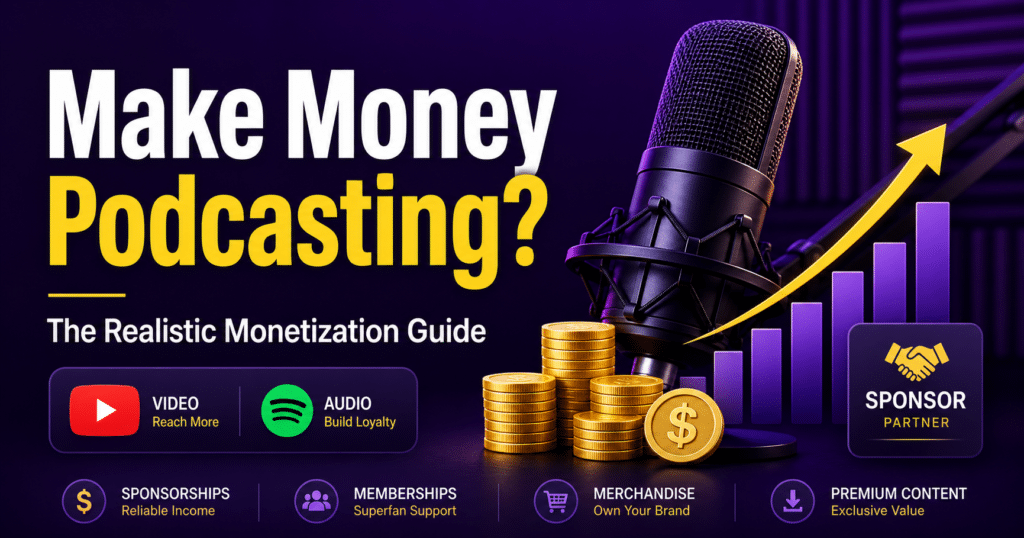
Can you really make money podcasting? Yes, you can. But the more honest answer is this: podcasting can make money when it is treated like a long-term content asset, not a quick money machine.
Many new podcasters start with this question because they see popular shows getting sponsors, YouTube views, brand deals, paid communities, affiliate income and even product sales.
But podcast income usually does not happen from episode one. Before a podcast makes money, it needs trust, consistency, audience clarity and a reason for brands or listeners to care.
So yes, you can make money podcasting. But the money usually comes after you build value first.
In this guide, we will break down how podcast monetization really works, the different ways podcasters can earn, what sponsors look for, and what beginners should focus on before trying to monetize too early.
Still planning your podcast from zero?
Read this guide first: How to Start a Podcast in 2026: Simple Tips for Beginners
Quick Answer: Can You Really Make Money Podcasting?
Yes, you can make money podcasting through sponsorships, YouTube ads, platform monetization, affiliate links, paid communities, digital products, services, live events and brand partnerships.
But for most podcasters, income comes after they build a clear niche, consistent content, engaged audience and enough trust for sponsors or customers to take them seriously.
Podcasting Can Make Money, But Not Instantly
Podcasting is similar to building a YouTube channel, newsletter, blog or personal brand. The income usually comes after the audience understands who you are, what your podcast is about and why your content matters.
If your podcast has only one or two episodes, it is usually too early to expect serious sponsorship or ad income. That does not mean the podcast has no value. It simply means you are still building the foundation.
The first stage of podcasting is not monetization. The first stage is positioning.
Before Podcast Income Comes, You Need:
- A clear niche and audience.
- Consistent episodes.
- Good audio quality.
- Strong episode topics and titles.
- Short clips for discovery.
- Trust with your audience.
- A reason for sponsors, customers or listeners to support you.
When these foundations are strong, monetization becomes more realistic.
1. Sponsorship: The Main Income Path for Many Podcasts
Sponsorship is one of the most common ways podcasts make money.
A sponsor pays to be featured in your podcast because your audience matches their target market. This can happen through host-read ads, product mentions, branded segments, episode sponsorships or long-term partnerships.
But sponsors usually do not pay only because you have a podcast. They pay because your podcast gives them access to the right audience with the right level of trust.
What Sponsors Usually Look For
- Audience fit: Does your audience match the sponsor’s target market?
- Engagement: Do people comment, reply, share or ask questions?
- Consistency: Are you publishing regularly?
- Brand safety: Is your content suitable for their brand?
- Trust: Do listeners believe your recommendations?
- Content quality: Does your podcast sound and look professional?
For many podcasters, sponsorship becomes realistic when the show has a clear niche and proof that the audience is active, even if the audience is not huge.
Want to approach brands for sponsorship?
Read this next: How to Get Sponsorship for Your Podcast
2. YouTube Monetization for Video Podcasts
If your podcast is published on YouTube, you may be able to earn through YouTube monetization once your channel meets the requirements.
This can include ad revenue, channel memberships, Super Thanks, Super Chat, Shopping features and other creator monetization tools depending on your eligibility and region.
However, YouTube monetization should not be your only podcast income plan. Ad revenue can be useful, but for many beginner and mid-sized creators, sponsorships, services, products or lead generation may produce stronger income than ads alone.
Why YouTube Still Matters for Podcast Monetization
- YouTube helps people discover your podcast through search and suggested videos.
- Full episodes can build watch time and trust.
- Shorts can bring new viewers to your show.
- Video helps sponsors see your production quality and host presence.
- Episodes can continue getting views long after they are published.
YouTube lists its Partner Program eligibility publicly, including the lower access tier at 500 subscribers with watch-hour or Shorts-view requirements, and full ad revenue sharing at higher thresholds. You can refer to the official YouTube Partner Program page for the latest requirements.
Planning to use YouTube for your podcast?
Read this guide: How to Start a Video Podcast on YouTube
3. Platform Monetization and Listener Support
Podcast platforms are also adding more ways for creators to earn.
Depending on your country, eligibility and hosting platform, podcasters may be able to earn through subscriptions, partner programs, ad programs, premium content or listener support.
Spotify for Creators, for example, highlights monetization options such as subscriptions and the Spotify Partner Program for eligible creators. You can refer to the official Spotify for Creators monetization guide for updated details.
Examples of Platform-Based Monetization
- Podcast subscriptions.
- Ad revenue share.
- Premium episodes.
- Video podcast monetization where available.
- Listener support or fan funding tools.
This path can be useful, but it still depends on audience growth and platform eligibility. You should treat it as one income stream, not the whole business model.
4. Affiliate Marketing
Affiliate marketing means you recommend a product or service and earn a commission when someone buys through your link.
This works well when your podcast has a niche audience that trusts your recommendations.
For example, a podcast about content creation may recommend microphones, lights, cameras, editing tools or online courses. A finance podcast may recommend books, apps or learning resources. A parenting podcast may recommend useful products or services for families.
Affiliate Marketing Works Best When:
- The product is genuinely useful to your audience.
- You have personally used or properly researched it.
- The recommendation fits the episode topic.
- You disclose affiliate relationships clearly.
- You avoid recommending random products just for commission.
Affiliate income may start small, but it can become a useful side revenue stream if your content keeps attracting the right audience over time.
5. Selling Your Own Products or Services
For many creators and businesses, the best podcast income does not come directly from podcast ads. It comes from what the podcast helps sell.
Your podcast can build trust, educate your audience and lead them toward your own products or services.
Examples of Products or Services You Can Sell Through a Podcast
- Consultation or coaching.
- Workshops or training programs.
- Digital products such as e-books, templates or mini courses.
- Physical products related to your niche.
- Agency or professional services.
- Membership community.
- Events or live sessions.
This is why even a podcast with a smaller audience can make money if the audience is specific and the offer is clear.
For example, a podcast with 500 loyal listeners in a valuable niche may create more business impact than a general podcast with 10,000 passive listeners.
6. Podcast as a Lead Generation Tool
For founders, consultants, coaches, agencies and service businesses, podcasting can work as a lead generation tool.
This means the podcast is not only making money from ads. It is helping potential clients understand your expertise, trust your perspective and eventually contact you.
How Podcast Lead Generation Works
- Someone discovers your podcast through YouTube, Spotify, TikTok, Reels or search.
- They listen to your ideas and understand your point of view.
- They begin to trust your expertise.
- They visit your website, follow your social media or contact your team.
- They become a lead, customer, client, partner or referral.
This is especially powerful for B2B, professional services and founder-led brands because the buying journey often needs trust before conversion.
Want to plan podcasting as a business strategy?
Read this guide: How to Plan a Podcast for Business
7. Paid Community, Memberships and Fan Support
If your podcast builds a loyal community, you can create paid spaces for deeper engagement.
This could be a paid Discord, private Telegram group, Patreon-style membership, monthly Q&A session, exclusive content, bonus episodes or behind-the-scenes updates.
Paid Community Works Best When:
- Your audience wants access to you or your community.
- Your podcast gives practical value, support or belonging.
- You publish consistently enough to keep members engaged.
- You offer something more valuable than the free episodes.
This model is not suitable for every podcast, but it can be powerful for education, niche communities, coaching, creator-led shows and industry-specific podcasts.
8. Live Events, Workshops and Brand Activations
Once your podcast has a community, you can extend it beyond recorded episodes.
Some podcasters make money through live podcast recordings, workshops, paid events, meetups, brand activations or community gatherings.
This works especially well when the podcast has a strong identity and people want to experience the show in person.
Event-Based Podcast Monetization Ideas
- Live podcast recording with audience.
- Workshop based on your podcast topic.
- Panel discussion with sponsors.
- Community meetup.
- Brand collaboration event.
- Ticketed training or masterclass.
Events are more work, but they can help strengthen community and create sponsorship opportunities beyond the podcast episode itself.
9. Repurposing Content to Support Monetization
One podcast episode should not remain as one podcast episode only.
If you want your podcast to make money, people need to discover it. That is where repurposing becomes important.
Short clips, quote posts, blog articles, newsletters and social captions help your podcast reach more people and create more entry points into your monetization funnel.
One Podcast Episode Can Become:
- 3 to 5 short clips for TikTok, Reels and YouTube Shorts.
- 1 YouTube full episode.
- 1 Spotify or Apple Podcasts audio episode.
- 1 blog post or show notes page.
- 1 newsletter.
- 1 quote graphic.
- Several LinkedIn or Facebook posts.
The more useful touchpoints you create, the easier it becomes for potential listeners, sponsors or customers to find you.
Want to turn one episode into many posts?
Read this guide: Cara Kitar Semula Kandungan Podcast Untuk Media Sosial
How Much Money Can a Podcast Make?
This is the question everyone wants to ask, but there is no single fixed answer.
A podcast can make nothing, a small side income, or become a serious business asset. It depends on the niche, audience size, engagement, monetization model, sponsor fit, platform strategy and consistency.
Instead of asking only “how many listeners do I need?”, ask:
- Who listens to my podcast?
- Do they trust me?
- Are they valuable to sponsors?
- Do they have a problem I can help solve?
- Can my podcast lead to a product, service, consultation or brand partnership?
A general entertainment podcast may need a large audience to earn significant ad revenue. A niche business podcast may earn through sponsorship, leads or services with a smaller but more valuable audience.
Podcast Monetization Methods Compared
| Monetization Method | Best For | What You Need |
|---|---|---|
| Sponsorship | Niche podcasts with engaged audiences | Audience fit, consistency, media kit and sponsor proposal |
| YouTube Ads | Video podcasts with strong views and watch time | YouTube Partner Program eligibility |
| Platform Monetization | Eligible creators on podcast platforms | Platform requirements, audience and qualifying content |
| Affiliate Marketing | Review, education, gear, niche or recommendation-based shows | Relevant products and audience trust |
| Products / Services | Creators, consultants, founders and businesses | Clear offer and audience problem |
| Paid Community | Niche communities and education-based podcasts | Loyal audience and extra value beyond free episodes |
| Events / Workshops | Community-driven shows and brands | Audience demand, event planning and sponsor or ticket strategy |
When Should You Start Monetizing Your Podcast?
You can think about monetization from the beginning, but you do not need to sell aggressively from episode one.
A better approach is to build your monetization path in stages.
Podcast Monetization Stages
| Stage | Focus | What to Do |
|---|---|---|
| Stage 1: Foundation | Episodes 1–5 | Clarify niche, improve audio, test format and publish consistently |
| Stage 2: Growth | Episodes 6–15 | Create clips, study analytics, improve titles and build audience habit |
| Stage 3: Trust | Episodes 15–30 | Collect feedback, define audience profile, prepare simple media kit |
| Stage 4: Monetization | After clear audience proof | Approach sponsors, promote offers, test affiliate links or paid products |
This is not a strict rule, but it gives you a realistic way to think about growth. The key is to avoid chasing money before your podcast has enough clarity and trust.
What Sponsors Want to See Before Paying
If sponsorship is your goal, prepare your podcast like a brand asset.
Do not only send a message saying, “Do you want to sponsor my podcast?” Give sponsors a clear reason to consider you.
Your Sponsor Pitch Should Include:
- Podcast name and concept.
- Target audience.
- Episode format and publishing schedule.
- Average views, downloads or reach.
- Social media reach and engagement.
- Short clip performance.
- Examples of past episodes.
- Sponsorship package options.
- Why your audience fits the brand.
Even if your podcast is still small, a clear niche and engaged audience can make your show more attractive than a general podcast with weak positioning.
Common Podcast Monetization Mistakes
Many podcasters struggle to earn because they try to monetize before the foundation is ready.
Avoid These Mistakes:
- Expecting money from the first few episodes.
- Choosing a topic only because it seems profitable.
- Ignoring audio quality and production consistency.
- Having no clear audience.
- Depending only on YouTube ads.
- Approaching sponsors without a media kit or clear offer.
- Accepting sponsors that do not fit the audience.
- Not repurposing episodes into short clips.
- Not including a clear CTA in episodes.
Podcast monetization works better when the podcast is built around value, not just income.
Beginner Checklist Before Monetizing Your Podcast
Before you try to monetize, ask yourself:
- Do I have a clear podcast niche?
- Do I know who my audience is?
- Have I published consistently for at least a few episodes?
- Do I have clean audio and presentable visuals?
- Do I have short clips to show reach and engagement?
- Do I understand which brands fit my audience?
- Do I have a simple media kit or sponsor proposal?
- Do I have a clear CTA for listeners?
- Do I have an offer, product, service or community to connect the podcast to?
FAQ: Can I Really Make Money Podcasting?
1. Can beginners make money podcasting?
Yes, beginners can eventually make money podcasting, but it usually does not happen immediately. Beginners should focus first on niche, consistency, audio quality, audience trust and content distribution.
2. How many listeners do I need to get podcast sponsors?
There is no fixed number. Some sponsors care about large reach, while others care more about niche audience fit and engagement.
A small podcast with the right audience can still be attractive if the audience matches the sponsor’s target market.
3. Is YouTube ad revenue enough to make money from a podcast?
It can help, but it should not be your only monetization plan. Many podcasters combine YouTube monetization with sponsorships, affiliate links, services, products, community or events.
4. What is the best way to monetize a podcast?
The best method depends on your niche. For many podcasts, sponsorships, lead generation, affiliate marketing and selling your own products or services can be more practical than relying only on platform ads.
5. When should I start looking for sponsors?
Start looking for sponsors when you have a clear audience, consistent episodes, proof of engagement and a simple media kit. Sponsors need to understand who listens to you and why that audience matters.
6. Can KL Podcast Studio help me create a more sponsor-ready podcast?
Yes. KL Podcast Studio can help creators and brands record podcasts with professional audio, video, lighting and production support, making the show look and sound more credible for audience growth and potential sponsorships.
Final Thoughts: Podcast Income Comes From Trust
So, can you really make money podcasting?
Yes. But podcast income usually comes from trust, consistency and a clear audience — not just from uploading episodes.
If you want to monetize your podcast, start by building a show that people actually want to return to. Choose a clear niche, publish consistently, make your audio comfortable to hear, create short clips, understand your audience and build relationships with the right brands.
Do not rush the money before the foundation is ready. Build the value first, then monetization becomes much easier to approach.
Ready to Build a More Sponsor-Ready Podcast?
Record your podcast at KL Podcast Studio and get a professional setup with microphones, cameras, lighting and production support — so your show looks credible, sounds clear and is easier to present to your audience and potential sponsors.