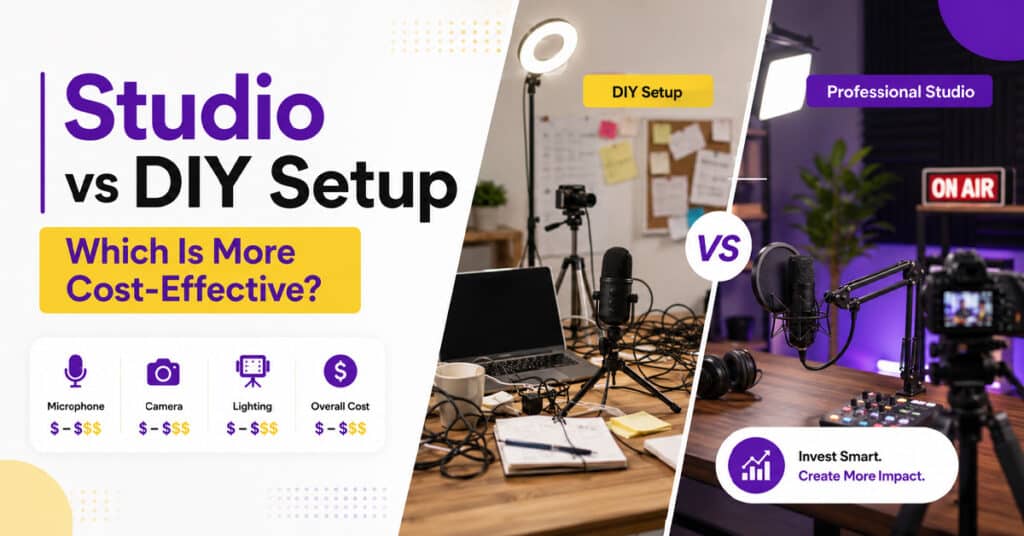
Podcast studio vs DIY setup is one of the biggest questions businesses ask before starting a podcast. At first glance, a DIY setup can seem cheaper. You buy a microphone, a camera, maybe a few lights, and start recording from your office or meeting room.
But once you look closer, the real cost is not just about gear. It is also about setup time, troubleshooting, staff workload, editing stress, and the quality of the final content.
For a business, podcasting is not just a creative hobby. It is a marketing, branding, and communication asset. That means your decision should not only be based on the cheapest starting point, but on which setup gives you the best return on time, consistency, and content quality.
So, should your business invest in a DIY setup or rent a professional podcast studio instead?
In this article, we break down the real difference between a podcast studio vs DIY setup, compare the hidden costs, and help you decide which one is actually more cost-effective for your business.
Still comparing overall podcast costs?
Read this first: Are Podcasts Expensive in Malaysia? Podcast Setup Cost Guide
Quick Answer: Is a Podcast Studio or DIY Setup More Cost-Effective?
For most businesses, renting a professional podcast studio is often more cost-effective at the start because it reduces upfront equipment costs, setup time, staff stress, and production mistakes. A DIY setup can be cheaper over the long term only if your business records very frequently, already has the right team, and is willing to manage the technical side in-house.
If you want professional results without spending months building the workflow yourself, a studio rental is usually the smarter business move.
Why This Decision Matters for Businesses
For solo creators, a DIY setup might be part of the fun. But for a business, podcasting usually serves a bigger purpose. You may be creating content to build authority, generate leads, strengthen your brand, educate clients, support recruitment, or repurpose content into social media clips.
That means every recording session has a business cost attached to it. If your team spends too much time setting up cameras, fixing audio, adjusting lights, or repeating takes because something went wrong, the “cheap” option may not actually be cheap anymore.
Before choosing between a podcast studio vs DIY setup, ask this question:
Are you trying to own equipment, or are you trying to produce useful business content efficiently?
What Counts as a DIY Podcast Setup?
A DIY podcast setup usually means your business records content in-house using equipment you buy and manage yourself.
This may include:
- Microphones
- Headphones
- Cameras or webcams
- Lighting
- Tripods or stands
- Audio interface or mixer
- Recording software
- Editing software
- A room or office space adapted for recording
In theory, this gives you full control. In practice, it also means your team becomes responsible for setup, testing, troubleshooting, file management, and consistency.
What Counts as a Professional Podcast Studio?
A professional podcast studio is a ready-made recording environment with proper acoustics, microphones, lighting, cameras, and support already in place.
Instead of buying and managing everything yourself, you book the space when needed and focus on recording.
At KL Podcast Studio, this can range from a straightforward podcast session to a multi-camera video podcast setup, depending on your business needs. Our rooms in Petaling Utama and Damansara Damai give businesses different options based on budget and production style.
The Real Cost of a DIY Podcast Setup
DIY setups often look attractive because the costs are paid once. But businesses should look beyond the purchase price.
1. Equipment Cost
Even a modest business setup can require a decent microphone, camera, lighting, headphones, stands, cables, and software. If you want the setup to look polished and sound reliable, costs can quickly increase.
And if you are recording with more than one person, the price multiplies.
2. Setup and Learning Time
Someone on your team has to learn how everything works. That includes:
- Microphone placement
- Audio level setting
- Camera framing
- Lighting angles
- File recording and backup
- Basic editing workflow
This time has a cost too — especially if your marketing or content team already has other responsibilities.
3. Room Limitations
You may already have an office or meeting room, but not every room is suitable for podcast recording. Echo, air-conditioning noise, road sound, and visual distractions can lower quality fast.
Fixing the room may require additional acoustic treatment, furniture adjustments, or ongoing compromises in audio quality.
4. Maintenance and Upgrades
DIY does not end after buying the first batch of gear. Equipment needs replacement, upgrades, cables go missing, batteries need charging, software changes, and someone must keep the whole system organised.
5. Opportunity Cost
This is the hidden cost many businesses underestimate.
If your content team spends half a day setting up and recording one podcast episode, that is half a day not spent on strategy, distribution, campaigns, or other high-value work.
The Real Cost of a Professional Podcast Studio
With a studio rental, you pay per session rather than building the whole system yourself.
This may feel more expensive per recording day, but it often saves money in other ways.
1. No Major Upfront Investment
You do not need to buy equipment before proving your podcast strategy works. This is especially helpful for businesses that are still validating the idea, testing formats, or recording monthly rather than weekly.
2. Faster Workflow
A studio is already prepared for recording. Your team can arrive, get briefed, and start the session with minimal technical stress.
This reduces wasted time and helps you focus on content rather than cables.
3. More Consistent Quality
Consistency matters for business branding. When every episode looks and sounds different, your brand experience also feels less consistent.
A studio gives you more repeatable quality in terms of sound, lighting, framing, and overall presentation.
4. Lower Staff Burden
Your business team does not need to become an in-house production crew overnight. That means less internal pressure and fewer avoidable mistakes.
5. Better First Impression for Guests
If your podcast includes clients, partners, leaders, or invited experts, a professional studio also creates a stronger recording experience and brand impression.
Podcast Studio vs DIY Setup: Side-by-Side Comparison
| Feature | DIY Setup | Professional Podcast Studio |
|---|---|---|
| Upfront Cost | Higher initial purchase cost | Low upfront cost, pay per session |
| Audio Quality | Depends on room, gear, and setup skills | More consistent and studio-ready |
| Video Quality | Depends on camera, lighting, and space | Professional lighting and camera setup |
| Setup Time | High | Low |
| Learning Curve | Steep | Much lower for the client team |
| Maintenance | Your team handles it | Handled by the studio |
| Best For | Frequent in-house production teams | Businesses that want efficient, polished output |
| Scalability | Needs more investment over time | Easier to scale with different room options |
Want a broader quality comparison?
Read this related article: Home Studio vs Professional Podcast Studio: Which Delivers Better Quality?
When DIY Setup Makes Sense for a Business
A DIY setup can still be the right move in some situations.
DIY may make sense if your business:
- Records very frequently, such as multiple times every week
- Already has a content or production team
- Has a suitable quiet room or office space
- Is ready to build an internal content workflow
- Wants full control over recording schedules
- Is willing to invest in upgrades over time
If your company is committed to producing podcasts as a regular internal asset and you have the manpower to manage it well, DIY can become cost-effective in the long run.
But it is rarely the easiest option in the beginning.
When a Professional Podcast Studio Makes More Sense
For many businesses, a studio rental is the smarter option — especially early on.
A studio usually makes more sense if your business:
- Is just starting a branded or corporate podcast
- Wants professional results without buying equipment first
- Only records weekly, biweekly, monthly, or campaign-based content
- Does not want the team to handle technical setup
- Needs a better experience for guests or executives
- Wants video podcast content ready for YouTube, LinkedIn, or social clips
Instead of spending months figuring out the setup, you can move faster, test your content strategy, and decide later whether a permanent in-house setup is worth it.
Business Example: What Looks Cheaper on Paper May Cost More in Practice
Let’s say a business chooses the DIY route because it wants to “save money.”
On paper, buying a starter setup might seem reasonable. But now the marketing team has to:
- set up the room,
- check audio,
- fix framing,
- adjust lighting,
- brief the guest,
- manage files,
- and handle post-session cleanup.
If the team loses several hours per session, or if the final video still looks average, the hidden cost can be much higher than simply renting a proper studio.
Businesses often think in terms of equipment cost, but the more useful question is:
How much time, quality, and internal energy are we spending to get one good episode out?
What About Studio Rental Pricing?
If you are comparing numbers, a studio rental is often easier to budget because the cost is clearer and more predictable.
At KL Podcast Studio, our room options let businesses choose based on their goals and budget. For example:
- Damansara Damai offers accessible options for simpler audio and video podcast sessions.
- Petaling Utama offers more premium studio environments, including higher-end multi-camera setups.
For exact packages and current options, businesses can review our Studio Rates, explore Petaling Utama Studio, or look at our Damansara Damai Studio page.
This also makes it easier to compare against your DIY budget more realistically.
A Smarter Way to Decide: Start With the Goal, Not the Gear
Many businesses start by asking, “What mic should we buy?”
A better question is:
What kind of content are we trying to produce, how often, and who in our team will own the workflow?
Once that is clear, the decision becomes easier.
If your goal is:
- Testing a business podcast idea → studio rental is often smarter.
- Launching a polished branded content series → studio rental gives faster quality.
- Recording frequent internal content with an experienced team → DIY may become worth it later.
- Creating better guest-facing content without technical hassle → studio rental wins.
Can You Combine Both?
Yes — and for many businesses, this is actually the best path.
You can start by renting a studio to:
- test your podcast concept,
- learn what workflow suits your team,
- understand how often you will really record,
- and build confidence before investing heavily in equipment.
Later, if podcasting becomes a regular part of your content strategy, you can decide whether it is worth building a partial or full in-house setup.
This approach reduces risk and helps you make a more informed business decision.
For Predictable Recording: Consider a Podcast Studio Access Plan
There is also a middle option between booking one-off sessions and building a full DIY setup: a Podcast Studio Access Plan.
This is useful for businesses, marketing teams and creators who already know they want to record on a predictable monthly schedule, but do not want to manage their own podcast room, equipment, camera setup and technical workflow.
Instead of buying everything yourself or booking ad-hoc every time, a studio access plan gives you reserved monthly studio hours based on your selected plan. This can make content planning easier because your team can treat podcast recording as a fixed part of the monthly content calendar.
Podcast Studio Access Plans may be suitable if your business:
- records podcast content every month,
- wants more predictable studio access,
- needs a professional 3-camera podcast setup,
- has an in-house editor or external post-production team,
- wants to batch record content on a fixed schedule,
- prefers not to manage equipment maintenance and setup,
- needs reliable studio quality without building an in-house studio.
For many businesses, this can be more practical than DIY because the recording environment is already prepared, while your team still gets a recurring structure for content production.
Studio Planning Note
If your business records only once in a while, standard studio rental may be enough. If you record every month with a clear schedule, a Podcast Studio Access Plan can help you lock in recurring recording time and reduce planning friction.
You can view the package details here: Podcast Studio Access Plans.
The key is not to choose the biggest package immediately. Start by looking at your real content schedule. If your team only needs occasional recording, book per session. If your team needs predictable monthly production, an access plan may make more sense.
Which Option Fits Your Business Best?
| Business Situation | Best Option | Why |
|---|---|---|
| You are testing podcasting for the first time | Studio rental | Lower risk and no major equipment investment |
| You record once in a while | Ad-hoc studio booking | Pay only when needed |
| You record every month on a fixed schedule | Podcast Studio Access Plan | More predictable studio access and content planning |
| You record many times every week | DIY or in-house setup | May become cost-effective if your team can manage production |
| You want polished executive or branded content | Professional studio | Better guest experience, quality and brand perception |
FAQ: Podcast Studio vs DIY Setup
1. Is a DIY podcast setup cheaper than renting a studio?
Not always. A DIY setup may seem cheaper upfront over time, but once you include equipment, room limitations, staff time, setup stress, and ongoing maintenance, it can become more expensive than expected.
2. When should a business rent a podcast studio instead?
A business should consider renting a podcast studio when it wants professional results quickly, does not want to manage technical setup internally, or is still testing whether podcasting fits its content strategy.
3. Is renting a podcast studio in KL worth it for business content?
Yes, especially if your goal is to create polished branded content, host guests confidently, and reduce the internal burden on your marketing team. It is often a more efficient path for businesses in Kuala Lumpur and the Klang Valley.
4. What is the biggest hidden cost of a DIY setup?
The biggest hidden cost is usually time. Someone has to manage setup, test recordings, fix issues, organise files, and often learn production skills on the job.
5. Can a business start with a studio and switch to DIY later?
Yes. This is often the smartest route. It lets you validate your podcast strategy first, understand your real recording frequency, and avoid over-investing in equipment too early.
6. What is a Podcast Studio Access Plan?
A Podcast Studio Access Plan is a monthly studio access package for businesses, teams or creators who record on a predictable schedule and want reserved monthly studio hours without building their own recording setup.
7. Which is better for a business podcast: studio rental, access plan or DIY?
It depends on your goals, frequency and internal team capacity. For testing or occasional recording, studio rental works well. For predictable monthly recording, an access plan may be more practical. For very frequent in-house production with a capable team, DIY can become worthwhile later.
Final Verdict: Which Is More Cost-Effective for Your Business?
If your business is just starting out, wants reliable quality, and prefers to focus on content rather than production stress, a professional podcast studio is usually the more cost-effective choice.
If your business records often, already has internal production capability, and wants to build a long-term in-house system, a DIY setup may become more economical over time.
If your business records every month and wants a more predictable content workflow without managing your own studio, a Podcast Studio Access Plan can be a practical middle ground.
But for most businesses, the smartest move is not to rush into equipment. It is to start with a clear content goal, test the workflow, and choose the setup that gives the best mix of quality, efficiency, and brand consistency.
In other words, the cheapest option is not always the most cost-effective one.
Need Help Choosing the Right Studio Setup?
Whether you need a one-off recording session or a polished multi-camera podcast setup, KL Podcast Studio can help you choose the right room for your business goals and budget.
For Monthly Recording
Record Every Month Without Rebuilding Your Setup
If your business records podcasts on a fixed monthly schedule, our Podcast Studio Access Plans can help you secure recurring studio time with a professional recording setup already prepared.