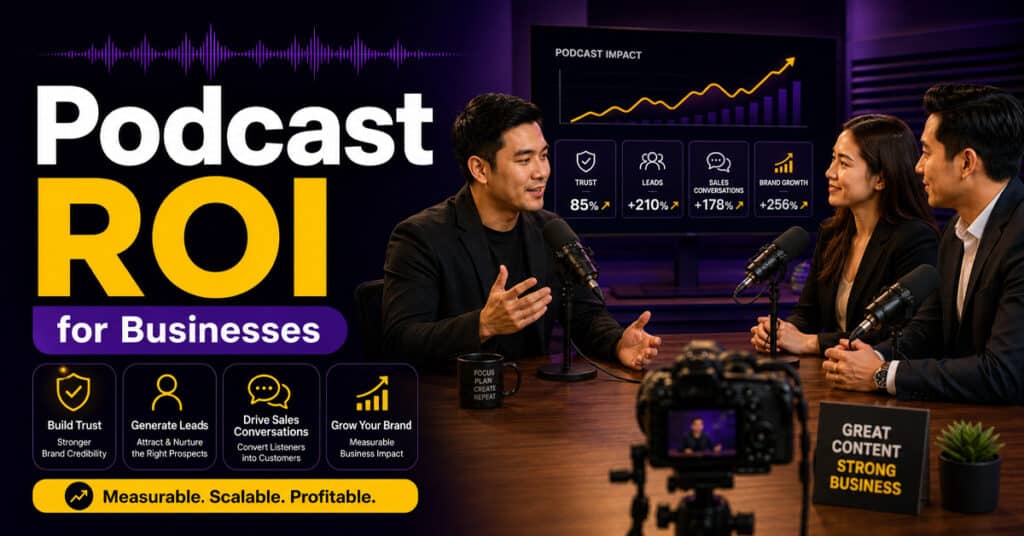
Podcast ROI is one of the most important questions businesses ask before investing in a podcast.
For many companies, the first question is simple: “How many views will we get?”
That is a fair question. Views matter. Downloads matter. Watch time matters. But if your business only measures podcast success by views alone, you may miss the real value of podcasting.
A business podcast is not the same as a viral entertainment clip. It can support brand trust, client education, thought leadership, sales conversations, internal communication, recruitment, partnerships, and long-form content strategy.
Some podcasts may not get millions of views, but they can still influence the right decision-makers, warm up future clients, strengthen your founder’s authority, help your sales team explain complex ideas, and give your marketing team weeks of reusable content.
In this article, we will break down how to measure podcast ROI for businesses beyond views — so your company can understand what a podcast is really doing for your brand, content strategy, and business growth.
Still deciding whether to rent a studio or build your own setup?
Read this first: Podcast Studio vs DIY Setup: Which Is More Cost-Effective for Your Business?
Quick Answer: How Do Businesses Measure Podcast ROI?
Businesses should measure podcast ROI by looking beyond views. Important metrics include lead quality, sales conversations, client education, brand authority, audience retention, short clip performance, content repurposing value, branded search, website traffic, partnership opportunities, recruitment value, and feedback from clients or prospects.
Views show reach, but ROI comes from whether the podcast helps your business build trust, create demand, support sales, and stay visible to the right audience.
Why Views Alone Are Not Enough
Views are easy to understand, which is why many businesses focus on them first.
If a podcast episode gets high views, it feels like success. If the views are low, it may feel like failure. But for business podcasts, this can be misleading.
A podcast episode watched by 300 highly relevant business owners, decision-makers, HR leaders, investors, clients, or industry professionals may be more valuable than a clip watched by 30,000 random people who will never become your customer.
For businesses, the better question is not only:
“How many people watched this?”
The better question is:
“Did the right people watch this, trust us more, and move closer to a business conversation?”
Views Tell You Reach. ROI Tells You Business Impact.
| Metric | What It Shows | What It Does Not Fully Show |
|---|---|---|
| Views | How many people clicked or watched | Whether the viewers were relevant to your business |
| Likes | Basic positive reaction | Whether people understood your offer or trust your brand |
| Comments | Engagement and conversation | Whether the engagement leads to business outcomes |
| Subscribers | Audience growth | Whether the audience fits your target market |
| Leads | Business interest | Still needs qualification and follow-up |
Views are part of the picture, but they are not the whole picture.
What Podcast ROI Means for Businesses
Podcast ROI means understanding what your podcast gives back to your business compared to the time, cost and effort invested.
For some businesses, ROI may mean direct enquiries. For others, it may mean stronger trust, better client education, more authority in the industry, or more content assets from one recording session.
That is why podcast ROI should be measured based on your business objective.
Different Businesses May Have Different Podcast Goals
| Business Goal | Podcast Role | Possible ROI Metric |
|---|---|---|
| Lead Generation | Warm up prospects and create trust | Enquiries, consultation requests, qualified leads |
| Brand Authority | Position leaders as trusted voices | Mentions, invitations, branded search, industry recognition |
| Client Education | Explain complex topics in a human way | Reduced repetitive questions, better-informed prospects |
| Recruitment | Show culture, leadership and company values | Better candidate understanding, employer brand engagement |
| Internal Communication | Share leadership messages and knowledge | Employee engagement, knowledge sharing, training adoption |
| Content Marketing | Create long-form content that can be repurposed | Number of clips, posts, articles, email content and campaign assets |
Before measuring podcast ROI, your business must first decide what the podcast is supposed to achieve.
Want to understand why podcasts matter for business strategy?
Read this article: Why Podcasting Should Be Part of Your Marketing Strategy
1. Measure Lead Quality, Not Just Lead Quantity
A podcast may not always bring a large number of leads immediately. But it can help bring better-quality leads.
When people listen to your podcast before contacting your business, they already understand your thinking, your values, your expertise and your approach. This can make the sales conversation warmer and more productive.
Questions to Ask:
- Are prospects mentioning the podcast during enquiries?
- Are leads more educated before speaking to your sales team?
- Are prospects asking better questions?
- Are people contacting you because they trust your perspective?
- Are clients sharing your podcast with other decision-makers?
For business podcasts, one strong qualified lead can sometimes be more valuable than thousands of casual views.
2. Track Sales Conversations Influenced by Podcast Content
Podcast ROI often appears inside conversations.
A potential client may say:
- “I watched your episode about this topic.”
- “Your founder explained that really well.”
- “I shared your podcast with my team.”
- “We feel like we understand your company better now.”
These moments are important. They show that your podcast is helping prospects move from awareness to trust.
How to Track This
- Add “How did you hear about us?” in your enquiry form.
- Ask your sales team to note when a prospect mentions a podcast episode.
- Use UTM links in podcast descriptions and short clip captions.
- Create landing pages for specific podcast campaigns.
- Track whether podcast viewers become consultation calls, proposals or clients.
This does not need to be complicated at the start. Even a simple spreadsheet can help your team understand how podcast content supports sales.
3. Measure Trust and Authority Signals
One of the biggest benefits of a business podcast is trust-building.
A podcast gives your audience time to hear how your company thinks. They can understand your point of view, your experience, your tone, and how you respond to real questions.
This is especially valuable for businesses that sell services, consulting, education, training, professional expertise, B2B solutions, or high-trust products.
Authority Signals to Watch
- Invitations to speak, collaborate or appear on other shows.
- More people searching for your founder or company name.
- More direct enquiries from people who already understand your expertise.
- Industry peers referencing your podcast content.
- Clients using your podcast episodes to explain your value internally.
Trust does not always show up as instant views. Sometimes it shows up months later as a better conversation, a warmer lead, or a stronger brand impression.
4. Measure Audience Retention and Watch Time
Views tell you whether people clicked. Retention tells you whether they stayed.
For YouTube podcasts, watch time and retention are especially useful because they show how engaging your episode is after the click.
If people click but leave very early, your issue may be the opening, pacing, topic clarity or audience expectation. If people stay longer, it means the content is delivering value.
What to Review:
- Average view duration.
- Audience retention curve.
- Where viewers drop off.
- Which parts create spikes or replays.
- Which episode formats keep people watching longer.
For business podcasts, retention can be more meaningful than total views. A smaller number of people watching deeply may indicate stronger trust and relevance.
Need to improve your episode opening and retention?
Read this guide: How to Hook Your Podcast Listeners
5. Measure Content Repurposing Value
One podcast recording can become many content assets.
This is where podcast ROI becomes very powerful for marketing teams. A one-hour recording is not just one video. It can become a full YouTube episode, short clips, blog posts, LinkedIn posts, quote graphics, newsletter content, website FAQs, sales enablement material and internal learning content.
One Podcast Episode Can Become:
- 1 full YouTube episode.
- 1 audio podcast episode.
- 5 to 10 short clips for TikTok, Reels, Shorts or LinkedIn.
- 1 blog article or show notes.
- 3 to 5 LinkedIn posts.
- Several quote graphics.
- Newsletter content.
- Sales follow-up material.
- Training or onboarding material.
When measuring ROI, calculate the value of the entire content library created from each session — not only the full episode views.
Example Content ROI Question
“If one recording session gives us one full episode and ten usable content assets, how much would it cost to create those assets separately?”
This helps your business see podcasting as a content engine, not just a single upload.
6. Measure Short Clip Performance
For many business podcasts, short clips are the discovery layer.
People may not watch a 60-minute podcast from a company they do not know yet. But they may watch a 45-second clip that answers a specific question or shares a strong insight.
That clip can then lead them to the full episode, your profile, your website, or your service page.
Short Clip Metrics to Watch
- Views per clip.
- Completion rate.
- Saves and shares.
- Comments from target audience.
- Profile visits after clip performance.
- Clicks to full episode or website.
- Which topics perform better as short-form content.
Sometimes, the full episode may have moderate views, but one clip can travel much further and introduce your brand to new audiences.
7. Measure Website Traffic and Branded Search
A podcast can increase search behaviour around your business.
After watching or listening, people may search your company name, founder name, service, studio, product, or topic. This is a sign that the podcast is creating curiosity and brand recall.
What to Track:
- Website traffic from podcast links.
- Traffic from YouTube descriptions or social captions.
- Increase in branded search terms.
- Visitors to service pages after podcast campaigns.
- Visitors to booking, contact or consultation pages.
- Newsletter sign-ups from podcast-related content.
Not every listener will convert immediately. Some will search later, return later, or mention your brand when the need becomes stronger.
8. Measure Client Education and Sales Enablement
Business podcasts can reduce friction in the sales process.
If your team keeps explaining the same things to prospects, those topics can become podcast episodes. Instead of repeating the same explanation manually, you can send the relevant episode before or after a sales call.
Podcast Episodes Can Help Explain:
- How your service works.
- Common misconceptions in your industry.
- What clients should prepare before working with you.
- How to compare options.
- Why your process is different.
- What results clients should realistically expect.
This kind of podcast content may not always go viral. But it can help prospects understand your business faster and make better decisions.
Sales Enablement Metrics
- Do prospects come to calls more informed?
- Are repeated questions reduced?
- Does the sales team use podcast episodes in follow-ups?
- Do clients share episodes internally with other stakeholders?
- Do proposals become easier to explain because the podcast already educated the prospect?
This is a practical ROI layer many businesses overlook.
9. Measure Guest and Partnership Value
If your podcast includes guests, the value is not only in the episode itself.
Guests can become collaborators, partners, clients, referral sources, community builders or brand advocates.
A strong business podcast can create relationships that would be difficult to build through cold outreach alone.
Guest ROI Can Include:
- Guest sharing the episode with their audience.
- New partnership conversations.
- Referral opportunities.
- Deeper relationship with clients or stakeholders.
- Access to industry experts and communities.
- Content credibility through trusted voices.
If your business podcast brings the right people into the room, the relationship value can be just as important as the view count.
10. Measure Recruitment and Employer Branding Impact
For some companies, podcast ROI can also appear in recruitment.
A podcast can show how your leaders think, what your company values, how your team solves problems, and what kind of culture you are building.
This can help candidates understand your company before they apply or attend an interview.
Employer Branding Metrics to Watch
- Candidates mentioning the podcast during interviews.
- Better understanding of company culture.
- Increased interest in company career pages.
- More relevant applicants.
- Employees sharing podcast episodes internally or externally.
Not every business podcast needs to focus on recruitment. But for companies competing for talent, this can be a valuable long-term benefit.
11. Measure Internal Communication Value
Podcasts are not only for external marketing.
Some companies use internal podcasts to communicate leadership messages, share training, document knowledge, onboard staff, or highlight team stories.
For larger companies, this can be useful when messages need to feel more human than an email or slide deck.
Internal Podcast ROI Can Include:
- Better leadership communication.
- Improved onboarding experience.
- Knowledge sharing between departments.
- Employee engagement with company stories.
- Training content that staff can revisit.
- More personal communication from leadership.
If your company is considering internal podcasting, the ROI may be measured through employee feedback, training adoption, communication clarity, or reduced repetition in internal briefings.
12. Measure Cost Per Useful Asset
A simple way to measure podcast ROI is to calculate cost per useful asset.
Instead of looking only at the cost of recording one episode, calculate how many usable content pieces you get from that session.
Example:
- 1 full video podcast episode.
- 1 audio episode.
- 8 short clips.
- 1 blog post.
- 3 LinkedIn posts.
- 5 quote graphics.
That is 19 potential assets from one recording session.
If those assets support your marketing, sales and brand for weeks or months, the ROI may be stronger than looking at full episode views alone.
13. Measure Long-Term Content Library Value
Podcast content can compound over time.
An episode published today may still be useful months later when a prospect searches for that topic, a salesperson sends it to a lead, or a short clip is reused in a campaign.
This is different from some short-form content that disappears quickly after posting.
Your Podcast Library Can Become:
- A knowledge base for your audience.
- A trust-building library for prospects.
- A sales support tool.
- A founder authority archive.
- A content bank for future campaigns.
- A training resource for team members.
When measuring podcast ROI, look at both short-term performance and long-term usefulness.
14. Measure Qualitative Feedback
Not all valuable feedback appears in analytics dashboards.
Sometimes the most important signals come from real people.
Useful Qualitative Signals Include:
- Clients saying an episode helped them understand your work.
- Prospects mentioning your podcast in meetings.
- Industry peers sharing or referencing your content.
- Employees feeling proud to share company episodes.
- Guests saying the episode helped them express their story better.
- Audience members asking deeper follow-up questions.
For business podcasts, qualitative feedback can be a strong indicator that the podcast is building trust, even before large numbers appear.
Podcast ROI Dashboard: What Your Business Should Track
To make podcast ROI easier to measure, create a simple dashboard or spreadsheet.
You do not need to track everything from day one. Start with the metrics that match your business goal.
| ROI Area | Metrics to Track | Why It Matters |
|---|---|---|
| Reach | Views, downloads, impressions, subscribers | Shows audience growth and discovery |
| Engagement | Watch time, retention, comments, shares, saves | Shows whether people care enough to stay or respond |
| Lead Quality | Enquiries, qualified leads, consultation requests | Shows business interest from the right audience |
| Sales Support | Episodes used in follow-ups, prospect mentions, proposal support | Shows whether podcast content helps sales conversations |
| Brand Authority | Mentions, branded search, speaking invites, collaborations | Shows trust and industry recognition |
| Repurposing | Number of clips, posts, articles, newsletter assets | Shows how much content value each recording creates |
| Internal Value | Employee feedback, onboarding use, training use | Shows internal communication or HR value |
This kind of dashboard helps your team stop judging podcast success based only on one number.
How to Set Podcast Goals Before Recording
The best time to define podcast ROI is before the first episode is recorded.
If your team does not know the goal, it will be difficult to measure success later.
Before Recording, Decide:
- Who is the podcast for?
- What business problem should it support?
- Is the goal awareness, trust, leads, education, recruitment or internal communication?
- What platform matters most — YouTube, Spotify, LinkedIn, website or internal channels?
- How will each episode be repurposed?
- What action should the audience take after watching or listening?
A podcast with a clear goal is easier to plan, easier to measure and easier to justify internally.
Planning a podcast for your company?
Read this related article: Podcast Studio vs DIY Setup or view our Studio Rates.
Common Mistakes Businesses Make When Measuring Podcast ROI
Many companies underestimate podcast value because they measure the wrong things too early.
Avoid These Mistakes:
- Judging the podcast after only one or two episodes.
- Only tracking full episode views.
- Ignoring short clip performance.
- Not asking leads where they discovered the company.
- Not connecting podcast topics to business goals.
- Recording episodes without a repurposing plan.
- Expecting viral results from content meant to build trust.
- Not involving sales, HR or leadership when the podcast supports their goals.
Podcast ROI becomes clearer when your team measures the full journey — from awareness to trust to action.
How KL Podcast Studio Helps Businesses Create Podcast Content With ROI in Mind
At KL Podcast Studio, we work with creators, founders, SMEs, brands and corporate teams who want to use podcasting as more than just a recording session.
For businesses, the right setup can help reduce friction and make the podcast easier to execute consistently. When the microphones, cameras, lighting and studio workflow are prepared, your team can focus more on the message, guests, questions and business objective.
We Can Support Business Podcasts Through:
- Professional podcast and video podcast recording.
- Multi-camera studio setup for branded content.
- Recording spaces for founders, leaders, clients and guests.
- Batch recording sessions for campaign or monthly content.
- Studio options for different budgets and production levels.
- Recording workflows that make repurposing easier.
- Support for businesses that want podcasting as part of their content strategy.
If your company wants to start a podcast, the first step is not only choosing a microphone or studio room. The first step is clarifying what success should look like for your business.
FAQ: Podcast ROI for Businesses
1. What is podcast ROI?
Podcast ROI is the business value your podcast creates compared to the time, cost and effort invested. It can include leads, trust, brand authority, sales support, content repurposing, recruitment value and internal communication benefits.
2. Are podcast views enough to measure success?
No. Views are useful, but they do not show the full business impact. A podcast with moderate views can still create strong ROI if it attracts the right audience, supports sales conversations and builds trust with decision-makers.
3. What should businesses measure besides views?
Businesses should measure lead quality, watch time, retention, short clip performance, website traffic, branded search, sales conversations, content repurposing value, guest relationships, recruitment impact and qualitative feedback.
4. Can a podcast help generate leads?
Yes, but not always in a direct or immediate way. Podcasts often warm up prospects, build trust and educate potential clients before they make an enquiry or speak to your sales team.
5. Is podcasting useful for corporate brands?
Yes. Corporate podcasts can support thought leadership, client education, internal communication, employer branding, stakeholder engagement and long-form content strategy.
6. Can KL Podcast Studio help businesses start a podcast?
Yes. KL Podcast Studio provides podcast and video podcast recording spaces, multi-camera setups and production support for businesses that want to create professional podcast content.
Conclusion: Podcast ROI Is Bigger Than Views
For businesses, podcast ROI should not be measured by views alone.
Views show reach, but they do not fully show trust, influence, lead quality, sales support, client education, recruitment value, internal communication, or the long-term value of your content library.
A strong business podcast can help your company become more visible, more trusted and more useful to the right audience. It can turn one conversation into many content assets. It can help prospects understand your expertise before they ever speak to your team. It can give your leaders a platform to explain ideas in a human way.
So before asking only “How many views did we get?”, ask better business questions:
- Did this episode reach the right people?
- Did it help explain our expertise?
- Did it create useful content assets?
- Did it support sales or client education?
- Did it build trust in our brand?
That is where the real ROI of podcasting begins.
Planning a Podcast for Your Business?
Record your business podcast at KL Podcast Studio and create professional long-form content that can support brand trust, client education, sales conversations and content repurposing.